

The GPI Report on the BRICS 2023 meeting, held in South Africa, indicated gradual progress in the institutional and policy development of the organization and interest is joining the organization from several countries, beyond the five founding members indicated in the acronym.
This paper is structured similarly to the 2023 GPI BRICS report to facilitate measuring the progress made during the past 12 months. Hence, there is a concentration on areas of BRICS activity that provide a structural underpinning for the grouping and an operational platform for further geoeconomic monetary system development and influence.
The 2024 meeting, held in Russia, formally included nine countries as members: Brazil, Russia, India, China, South Africa, Egypt, Ethiopia, Iran, United Arab Emirates. Around 30 countries have sent observers, including 12 who may have interest in joining in the future: Cuba, Bolivia, Thailand, Vietnam, Malaysia, Indonesia, Belarus, Türkiye, Nigeria, Uganda, Kazakhstan, and Uzbekistan. Of these countries it is notable that Türkiye (a NATO member) has applied to become a BRICS member). The UN Secretary General, António Guterres, also attended (despite criticism from Ukraine.
One should be cautious about expecting a substantial expansion of BRICS in terms of countries joining. Decisions are taken by consensus and the large countries, China and India, have an effective veto that they would not wish to lose. At a recent BRICS foreign ministers meeting in New York there was disagreement over a proposal by India, Brazil, and South Africa to seek support for permanent seats on the UN Security Council. Egypt and Ethiopia rejected the proposed joint statement.
BRICS Plus expands the BRICS platform not only to bring in other countries, but also to continues the process of establishing links with regional partners involved in wider regional integrating institutions, including Mercosur, Eurasian Economic Union, South African Customs Union, South Asian Association for Regional Cooperation, ASEAN. BRICS-Plus is intended to form an expanded platform that can coordinate policies with BRICS’ regional partners across four continents.
There is little doubt that in the year that has elapsed since the last BRICS meeting the continuing turmoil across the world, including armed conflicts have led to an increased bifurcation of world opinion on the issues confronting the world. This has not been driven by BRICS, but essentially by US foreign policy interests and actions. In 2024, the need for and alternative geopolitical voice as led to the BRICS forum coming of age in international terms. It seems likely that 2025 will see a limited expansion of members and a greater awareness of BRICS.
The interest in this loose-knit international grouping – whose establishment and development is more a defensive reaction against the intensity of the US-led Western powers geopolitical dominance – is driven by a desire for a supplementary international forum to that of the Western fora, such as the G7. As the Kazan communique consistently emphasizes it seeks not to supplant the G20, the WTO, IMF, and other institutions. but to reinforce many of their initiatives within the current international order, though with changes to reflect the changing world geoeconomic order.
Given the collective scope of BRICS Plus, there are clearly divergent interests. Achieving consensus on any major geopolitical issue is going to be difficult as the issue of UN security council membership reform indicates. For this reason, it is the development of technical monetary and trade initiatives where one should look for BRICS progress.
However, BRICS does offer a different geopolitical voice, not only for the countries involved, but also much of the Global South, whose views are currently ineffectual in geopolitical terms. With the UN powerless to act, for instance, against Israel’s disproportionate aggression in Gaza and in Lebanon, BRICS supports the UN call for the end to breaches of international law, including by Israel.
Given the involvement of Russia, these sentiments sound a jarring note and calls for diplomacy rather than miliary aggression sound somewhat hollow in respect of Russia, despite the complexity of the three-cornered dilemma involving Ukraine, Russia, and the West. For some of the countries, and Russia in particular, the impact of US and EU sanctions increases their motivation to press for more rapid progress in geopolitically challenging the West than are India and China.
Monetary Initiatives
The geoeconomic motivation of the BRICS is as strong as its geopolitical motivation. Hence, there is a clear, albeit gradual, drive to develop existing BRICS technical monetary initiatives. In particular, the desire to establish complementary international trade payments network to the one dominated by the US dollar. The ambition and potential feasibility of achieving this objective is indicated by the collective size of this BRICS Plus grouping. Albeit that the member countries are spread across the globe, they together account for 35% of the world’ GDP in PPP terms; c25%% of total world trade, and a global population share of 44.5%. As importantly, the share of global trade in goods transacted among the group’s current members more than doubled, to 40%, from 2002 through 2022 (BCG 2024).
An idea of BRICS geoeconomic progress, albeit gradual, since 2000, is provided in the table below from the ING bank (ING 2024).
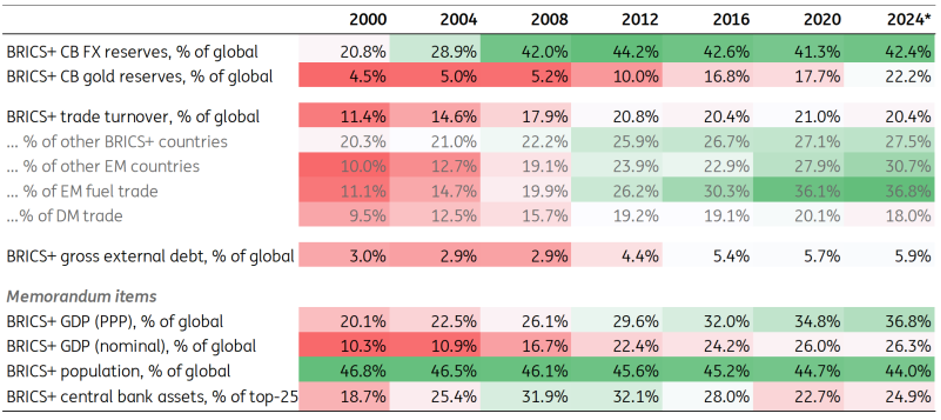
Notes
Latest available data from 2022-24.
BRICS+ Include current nine full member states
BRICS correspond to just five core member states
Shares of BRICS+ in financial flows are retrospectively adjusted for FX revaluation effects
Source: IMF, WB, BIS, SWIFT, Refinitiv, national sources, ING
Although BRICS+ controls 42% of global central bank FX reserves, likely contributing to the global de-dollarisation process. Gold is the biggest potential alternative to the US dollar for the bloc. Despite active buying by BRICS+, gold is still only 10% of their central bank reserves, half of the global average (ING 2024).
BRICS Pay: Gradual Evolution 2018 – 2024
The BRICS Pay initiative from 2018 first proposed linking the credit or debit cards of BRICS citizens to online wallets, accessible 24/7 for payment via a mobile application installed on their smartphones. The pilot project started in South Africa in early April 2019. However, the BRICS Pay system is also part of BRICS’ collective effort to establish a common system of payments for trade transactions between its members. In 2020, the Russian BRICS Presidency proposed the idea of a commercial ‘BRICS Pay’ for ‘BRICS’ countries for the consideration of the BRICS Business Council (BRICS Business Council 2020: 67). The BRICS Pay system has been gradually developing since then.
The biggest advantage of BRICS Pay is in developing an integrated network payment system, using distributed ledger technology (DLT). Such a structure would make possible the use of BRICS members’ national digitized currencies used for external payments, over the DLT network, and thus avoiding the use of the US dollar for trade payments. Currently, external settlements between BRICS members still require a conversion into US dollars, which requires the engagement of US banks. The BRICS Pay system would thus allow the members to reduce their dependence on international payment organizations such as the SWIFT network.
This structure would enable China’s current international clearance and settlement system (CIPS) to be able avoid using (as it now does) the SWIFT messaging system to provide integration with the overall international payments system. This is an indication of the further road that the BRICS payments system has to travel. However, China has been a long-term participant (as has UAE now a new BRICS member) in the BIS-led mBridge central bank digital payments project. The BIS, a few days after the BRICS discussion of the project, unexpectedly announced it was leaving the project, effectively handing over to China (Long 2024). BIS is still involved with a similar project, Agora, that involves Western central banks.
Increasing solidarity within the BRICS, and in South-East Asia, is also demonstrated by the Contingent Reserve Arrangement (CRA) – (Wurdemann 2018) – that has continued to be available within the BRICS to protect against threats to financial stability. There are no statistics on its actual use.
Hence, further progress has certainly been made in 2024 in developing an alternative payments system less reliant on the US dollar. It remains to be seen how rapidly BRICS Pay will develop a substantial global presence in the future and be able to challenge the incumbent SWIFT system at a global level. SWIFT is itself innovating to move on from being a global messaging service to a payments system set in the context of digitization and tokenization.
BRICS Clear
A further initiative, in the context of digitization is the development of BRICS Clear as a digital assets repository and trading system, analogous to the European-based Euroclear system.
The Euroclear system is an inter-bank payment system that settles securities transactions and provides related services for financial institutions in over 90 countries. It is a global provider of Financial Market Infrastructure (FMI) services, facilitating settlement of domestic and cross-border securities transactions and the safekeeping of securities investments (repository). It provides marketing and liquidity services for issuers of securities, investors and their custodians, and brokers and dealers. Its scope is also international in terms of being a repository for securities. (Euroclear 2024)
The establishment of BRICS Clear will mark a significant step in providing a securities repository for BRICS members and a securities trading platform, as an alternative to Euroclear. Though there are some older and newer competitors for Euroclear, it has been in operation for almost 60 years. Currently Euroclear uses SWIFT as the messaging service and for the time being BRICS Clear would also use SWIFT.
De-dollarization: Further Movement?
Another suggestion, promoted strongly by Russia, is that of the BRICS creating a BRICS currency, analogous to the Euro. The Russian proposal is to link a potential BRICS currency to either a basket of commodities or to gold. There is no evidence of such ideas becoming a realistic proposition to be considered by the BRICS group. With enlargement such an agenda appears even less likely to see any movement.
However, this does not mean that there will not be incremental change, given the BRICS initiatives briefly discussed above. There are various dimensions of currency usage within the global monetary and financial system, including goods trade. Nonetheless, overall change will be slow and less radical than might be envisaged. For instance, as argued by Bishop and Payne, in relation to trade, investment, and supply chains:
It is difficult to envisage a decisive decoupling of West from East, or a definitive process of ‘deglobalisation’. The sheer volume of trade in goods and services, the flows of capital, data and people across borders to facilitate it, the extent of economic interdependence and the complexity of global value chain-based production, which relies on inputs sourced from around the world, all militate against it (Bishop 2022).
Moreover, from a monetary viewpoint it is worth remarking that 90% of foreign exchange payments are made in US dollars. Almost 80% of publicly traded debt is dollar denominated. The US dollar is also the main reserve currency, representing 58% of foreign reserves held by global central banks. It may be suggested that there has been a gradual decline if the use of the US dollar as a reserve currency, but there is no evidence of any severe reduction in its use to cover liabilities. Hence, for the time being the BRICS countries, including China. are also reliant on use of the US dollar (Liu and Papa 2022).
Nonetheless, and especially in relation to trade finance the BRICS initiatives and the increased bilateral trade finance using national currencies, within a new BRICS digitized DLT network (as suggested above), will in time have a gradually increasing impact in the share of global trade not using the US dollar.
New Development Bank (NDB)
There was no detailed discussion of the New Development Bank. The Bank has its headquarters in Shanghai, China and an Africa Regional Centre was established in Johannesburg, South Africa (BRICS Business Council 2020). However, remarks by Mrs. Dilma Rousseff, the President at the BRICS meeting, indicated that the NDB’s efforts in mobilising much needed financial resources for infrastructure and sustainable development in emerging markets had continued, although highlighting the gaps that remain. Mrs Rousseff remarked,
We have indeed implemented and allocated a substantial amount of funds towards a variety of projects. However, this remains insufficient relative to the needs of the Global South. Therefore, it is crucial to provide funding in national currencies and in specialised formats. The New Development Bank is dedicated to this endeavour, funding not only sovereign projects but also private initiatives
And concluded that:
In this context, both the expansion of BRICS and our emphasis on ensuring the necessary financial resources for projects in the countries of the Global South are of paramount important. (New Development Bank 2024)
Conclusion
There is little doubt that the recent enlargement of the BRICS is a significant global event, with the reported geoeconomic progress that has been made in recent years including 2023/2024. Although there is further development to be undertaken, the shape of a collaborative and complementary international monetary structure being gradually developed under the aegis of BRICS may now be seen. The international monetary initiatives undertaken by the BRICS since 2020 – especially on the developing BRICS Pay network, and now also BRICS Clear – are revealing. As opposed to the disparaging views of some commentators (OMFIF 2024), the leading Western nations in the G7 will need to monitor further BRICS progress in this area, as will global financial institutions and businesses.
The situation should not be seen as necessarily to be viewed competitively by the West, as the Kazan communique makes clear. What we are witnessing is an attempt to engender a rational evolution of the global economy and global polity, aimed at avoiding the geoeconomic bifurcation advocated by the US in the New Washington Consensus (NWC). The BRICS aim appears to be a complementary bipolar global system. Bizarrely, especially given the comments of Western commentators, the BRICS are intending to revive the institutions of the old international order. Unfortunately, the attitude of the US in the last decade has been unhelpful for any attempt to achieve a degree of consensus on the need to reform the global trade and monetary systems. It is worth noting the remarks of former US Treasury Secretary Jack Lew. In 2016, he warned that “the more we condition the use of the dollar and our financial system on adherence to US foreign policy, the more the risk of migration to other currencies and other financial systems in the medium-term grows” (Lew 2016).
The attempt of the US to maintain a multi-factorial hegemony in this manner will ultimately prejudice the essential need to reform the global monetary system, to the benefit of all countries, including the US. China is careful to avoid any suggestion that it wishes to replace the US in terms of challenging the US international position and instead emphasizes the need for international reform of the monetary system (Zhou 2009) and a return to reviving the failing international order.
It has to be admitted that the Russian motivation is perhaps less clear. Russia does appear to want a competing monetary system founded on a commodity-based BRICS currency, linked to gold. Its problem is that nether China nor India is willing to adopt the Russian proposal to advance. Without their support this proposed Russian suggestion will not be adopted by the BRICS. Moreover, it is not clear that other BRICS Plus members would be in favour. Nor in an era of digitized central bank fiat currencies is the idea of a commodity-based currency a practicable or desirable initiative.
However, the US attempt to isolate Russia in both geoeconomic and geopolitical terms has not been as successful as the US hoped. Nor is its ambivalent approach to China helpful, except in further attempting to divide a world that requires greater not diminishing solidarity and cooperation, both geoeconomically and geopolitically.
The evolution of BRICS represents a signposting to a more cooperative future, not only for the BRICS members. The opportunity for global dialogue should be grasped by the G7 – perhaps mediated through the G20. It is an opportunity, as with the climate change agenda, to establish meaningful and productive dialogue across the supra-regions and continents of the world, whatever the national interests of individual nation states, including the US.
Unfortunately, as a footnote, the recent election of Donald Trump as the next US President may well presage an intensified aggressive US trade stance towards China in particular. However, it may also mean a less intensive pursuance of the ‘US-led West against the Rest’ policy, and a weakening drive towards the New Washington Consensus that enshrines this policy.
References
Kazan Declaration (2024) ‘Strengthening multilateralism for just global development and security’, XVI BRICS Summit, 23 October, http://static.kremlin.ru/media/events/files/en/RosOySvLzGaJtmx2wYFv0lN4NSPZploG.pdf
BCG (2024) ‘An Evolving BRICS and the Shifting World Order (in International Trade)’, 29 April, https://www.bcg.com/publications/2024/brics-enlargement-and-shifting-world-order
Bishop, M. (2022) ‘The BRICS countries: where next and what impact on the global economy?’, Economics Observatory, 20 October, https://www.economicsobservatory.com/the-brics-countries-where-next-and-what-impact-on-the-global-economy
BRICS Business Council. (2020) ‘Annual Report 2020’, https://brics-russia2020.ru/images/114/83/1148381.pd
BRICS (2024) Documents, https://brics-russia2024.ru/en/docs/
Brookings (2024) ‘What to Expect from BRICS 2024’, 14 October, https://www.brookings.edu/articles/what-can-we-expect-from-the-2024-brics-summit/
Euroclear (2024) https://www.euroclear.com/en.html
ING (2024) ‘De-dollarisation: More BRICS in the wall’, 23 October, https://think.ing.com/articles/de-dollarisation-more-brics-in-the-wall/
Lew, J. (2016) ‘Remarks of Secretary Lew on the Evolution of Sanctions and Lessons for the Future at the Carnegie Endowment for International Peace’, U.S Department of Treasury’, 30 March, ‘U.S. Treasury Secretary Jacob J. Lew on the Evolution of Sanctions and Lessons for the Future’, Carnegie Endowment for Peace, 30 March, https://carnegieendowment.org/events/2016/03/us-treasury-secretary-jacob-j-lew-on-the-evolution-of-sanctions-and-lessons-for-the-future?lang=en
Liu, Z. Z. and Papa, M. (2022) Can BRICS De-Dollarize the Global Financial System?, Cambridge University Press.
Long, K. (2024) ‘Explainer: BIS backs out of CBDC project mBridge’, The Banker, 21 October, https://www.thebanker.com/Explainer-BIS-backs-out-of-CBDC-project-mBridge-1730397190
New Development Bank (2024) ‘NDB President Dilma Rousseff Met with Vladimir Putin, President of Russia, BRICS Chair Country in 2024’, 23 October, https://www.ndb.int/insights/ndb-president-dilma-rousseff-met-with-vladimir-putin-president-of-russia-brics-chair-country-in-2024/
OMFIF (2024) ‘BRICS Look Increasingly Like a Paper Tiger’, 29 October, https://www.omfif.org/2024/10/brics-looks-increasingly-like-a-paper-tiger/?mc_cid=0a8fb360cd&mc_eid=ded694ede3
Würdemann, A. I. (2018) ‘The BRICS Contingent Reserve Arrangement: A Subversive Power Against the IMF’s Conditionality?’, The Journal of World Investment & Trade, 19(3): 570-593, https://doi.org/10.1163/22119000-12340099
Zhou, X. (2009) ‘Reform the International Monetary System’, BIS Review, 41, 23 October, www.bis.org/review/r090402c.pdf